
If you already hold a Texas License to Carry, the honest answer to “do I still need a class to work armed in Plano?” is yes: and the reason is more interesting than a bureaucratic shrug.
Why Doesn’t My LTC Cover Working Armed?
Because a License to Carry was built to regulate a private citizen carrying a personal firearm. Every part of it, the eligibility screen, the training, the proficiency demonstration, is aimed at that situation. It was never designed to say anything about a person standing in a lobby in a uniform, on contract, holding a position of responsibility over other people’s premises and safety. That is a different set of facts, and Texas answers it with a different credential: the security officer commission, an occupational license rather than a personal one.
The mechanism is §35.141(a)(2), which requires the Level 3 training course of anyone seeking a security officer commission, and of personal protection officers. It is stated as a flat requirement. There is no exemption for existing carry license holders, no equivalency provision and no partial credit, and the reason is that the rule and the LTC are not measuring the same thing in the first place. A contractor screening applicants for an armed post in a Legacy-area corporate campus is looking for the commission, and cannot accept a carry license in its place even if they wanted to.
So Does Any of My Carry Experience Count?
Genuinely, yes. On the range, and more than you might guess. The firearms proficiency exam for a commission is close to identical in format to the Texas LTC proficiency exam, and that similarity is baked into the rule rather than being a happy accident. §35.145 provides that the qualification may be conducted using either the DPS Primary Issued Handgun Qualification Course or the DPS Approved LTC Course. In other words, one of the two qualification pathways the state will accept for your commission is the very course of fire you shot for your carry license. If you have kept your skills up, the shooting portion of Level 3 Part 2 is not a leap into the unknown. It is a familiar drill under a new heading.
You can also go beyond the handgun. §35.146 sets out a shotgun course of fire for commissioned security officers, giving you the option to qualify with a shotgun in addition to the handgun. Some armed posts value it, and it costs you nothing to know the option exists before you turn up.
Where the Course Goes Somewhere Your LTC Never Did
The classroom half is the substance of the difference. Level 3 Part 1 covers the law that governs armed security work specifically, use of force, and the duties that attach to holding a commission. The professional obligations you pick up the moment carrying stops being a private choice and becomes part of a job. None of that appears in carry license training, because none of it applies to a private citizen. That material, incidentally, is prepared by and obtained from DPS. A school does not author its own version of it.
And the exam standard is higher than the one you have met before. Under §35.144(c), the minimum passing grade on Level 3 and Level 4 school examinations is 75%: above the Texas License to Carry written test threshold. It is worth saying plainly, because the students most likely to skim the reading are the confident, experienced ones.
While we are on the subject of things that get mixed up: Level 3 and Level 4 are not two rungs of one ladder. Level 3 is the commissioned security officer, the armed officer working a post. Level 4 is the personal protection officer, close protection, a separate course with a minimum of fifteen classroom hours under §35.141(a)(3). Level 4 is not a general advanced armed qualification, and taking it does not substitute for Level 3.
What the Path Actually Looks Like From Here
The unarmed Level 2 Security Officer course comes first and you keep that certificate, because under §35.81(a) the commission application requires copies of both the Level 2 and the Level 3 certificates of completion, along with the other items DPS lists. Level 3 then runs in two parts: Part 1 online, which ETXSTA delivers 100% online and which covers the classroom material and the written exam, and Part 2 in person, covering defensive tactics, firearms handling and the firearms proficiency exam. The online course price covers the online training only; the in-person firearms qualification is scheduled separately and is not included.
One detail that catches employers out as often as students: Level 3 may only be taught by a DPS-approved school using a DPS-approved instructor. Unlike Level 2, a licensed company cannot have its own designee deliver it in-house. When you qualify, §35.147 requires the school to issue your original certificate of completion, PSP 30, within seven days, and to retain training records for 24 months. And finishing the class is not the finish line: the commission itself is issued by DPS on application, and keeping it current afterwards runs through the armed security renewal course.
Plano Rewards the Commission
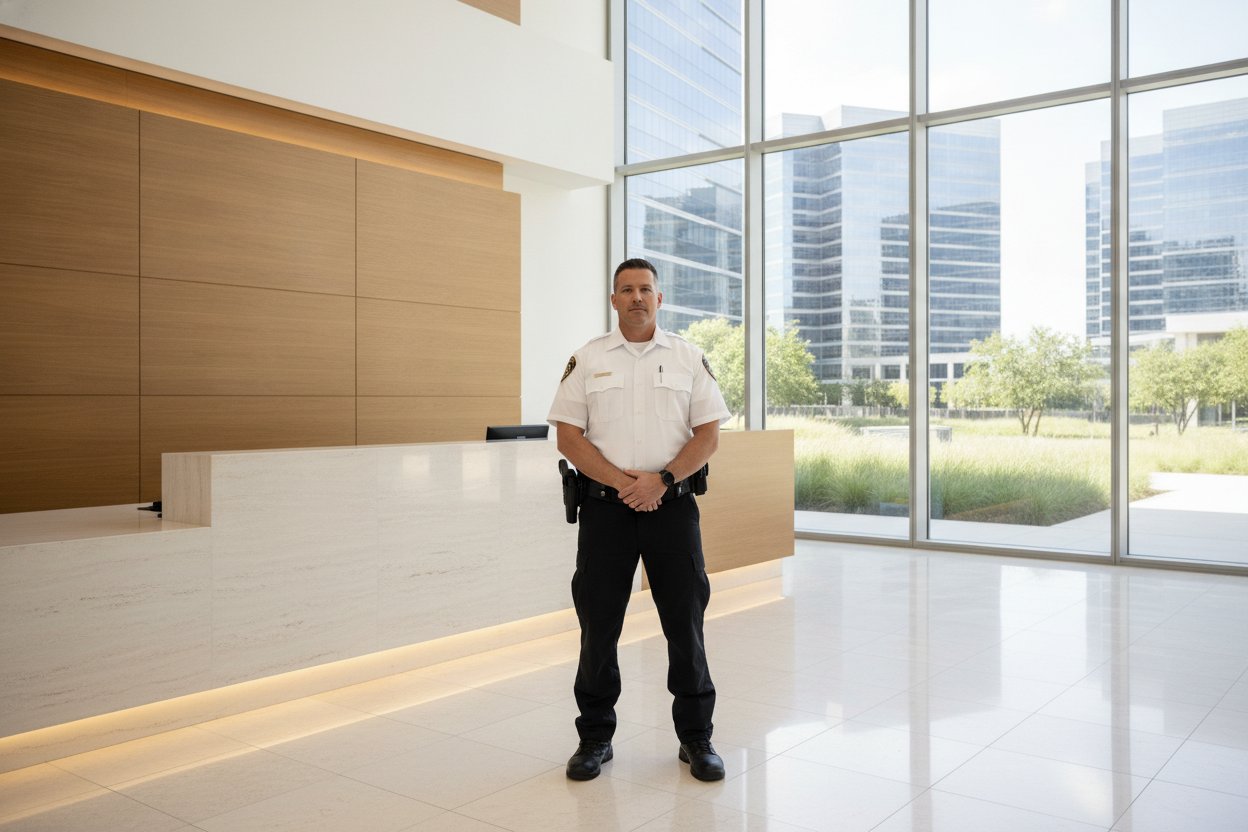
Plano is one of the densest corporate-headquarters markets in Texas, and the glass office parks that define its skyline come with exactly the security profile you would expect: staffed lobbies, controlled campus access, executive floors and after-hours coverage. Layer on the banking and financial branches, the medical office corridors, the data and technology facilities and the high-value retail around the major centers, and there is a substantial base of posts here that specify a commissioned officer rather than an unarmed one. Officers who hold the commission in this market simply have more doors open, and corporate clients tend to be specific about credentials in a way that a smaller market may not be.
You can read the underlying rules yourself in 37 TAC Chapter 35, the licensing process belongs to the Texas DPS Private Security Bureau, and our full class list shows how the courses fit together.
Leave a Reply