“I’ve had my LTC for years: I can work armed, right?” It is the single most common thing we hear from Odessa applicants, and the answer is no. Not because your license is wrong, but because it answers a different question than the one a security contractor is asking.
Two Different Documents, Two Different Jobs
A License to Carry is a personal credential. It speaks to you as a private citizen and to how you may lawfully carry your own firearm going about your own business. A security officer commission is an occupational credential. It is what allows a person to carry a firearm while performing the duties of a security officer: on someone else’s property, on a contract, in a uniform, with authority the public is expected to recognize. Texas regulates those two things separately because they create different risks and different duties.
The rule that sets this out is 37 TAC §35.141(a)(2), which requires the Level 3 training course of anyone seeking a security officer commission, and of personal protection officers as well. There is no carve-out in it for people who already carry. Your LTC is not a substitute, a shortcut or a partial credit. It simply is not the credential the rule is talking about.
What Your LTC Does and Does Not Carry Over
- It does not replace Level 2. The unarmed Level 2 Security Officer course still comes first, and you keep that certificate. Under §35.81(a) the commission application requires copies of both the Level 2 and the Level 3 certificates of completion.
- It does not replace Level 3. The classroom material behind a commission is the law that governs armed security work, use of force, and the duties that attach to the commission itself. None of that is on an LTC syllabus.
- It does help you at the range. This is the real overlap, and it is a genuine one. See the next section.
- It does not issue the commission. The commission is issued by DPS on application. Finishing the course qualifies you to apply; it is not the license.
The Range Is Where Your Experience Actually Pays Off
Here is the encouraging half. The firearms proficiency exam for a commission is close to identical in format to the Texas LTC proficiency exam. If you have shot one, the other will not surprise you. Under §35.145 the qualification may be run using either the DPS Primary Issued Handgun Qualification Course or the DPS Approved LTC Course. That is not a coincidence; it is the state deliberately reusing a course of fire you may already know. And §35.146 lays out a shotgun course of fire for commissioned officers, so qualifying with a shotgun in addition to a handgun is an option if you want it on your record.
Where the two part company is the written side. The minimum passing grade on Level 3 school examinations is 75% under §35.144(c). A higher bar than the LTC written test. Shooters who breeze through the range sometimes underestimate that exam. Read the material properly.
Level 3 Is Not Level 4
Worth clearing up while we are correcting assumptions. Level 3 is the commissioned security officer. The armed officer on a post. Level 4 is the personal protection officer, the executive-protection credential, a separate course carrying a minimum of fifteen classroom hours under §35.141(a)(3). They are not two grades of the same badge, and Level 4 is not a generic “advanced armed” tier. Take Level 3 for armed post work.
Why This Matters in the Permian Basin
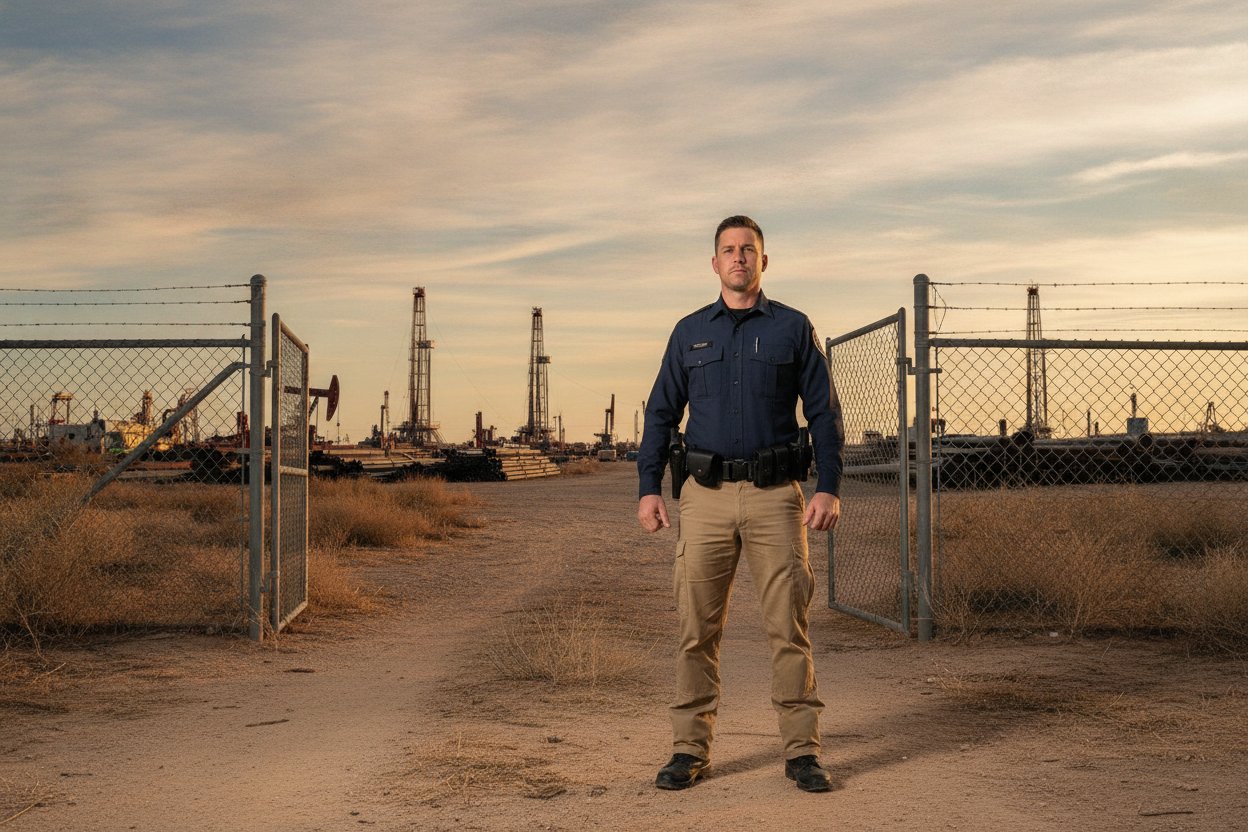
Odessa sits in a part of Texas where a great many people already own and carry firearms, which is exactly why the misconception is so widespread here. It is also a market with a real appetite for commissioned officers: energy and industrial sites with equipment yards and controlled gates, the hospital and medical district, banking branches, and the distribution and logistics operations that keep oilfield service companies supplied across the Basin. Those are armed posts, and they hire on the commission, not on a personal carry license.
The other West Texas reality is distance. Odessa officers are used to driving for training, so the structure here helps: Part 1 runs 100% online, the classroom material and the written exam, and Part 2 is in person, covering defensive tactics, firearms handling and the proficiency exam. The online course price covers the online training only; the in-person firearms qualification is scheduled separately and is not included.
Who Is Allowed to Teach It
- The course material is prepared by and obtained from DPS: a school does not write its own.
- Level 3 may only be taught by a DPS-approved school using a DPS-approved instructor. Unlike Level 2, a licensed company cannot have its own designee deliver it in-house.
- Under §35.147, the school issues your original certificate of completion, referred to on this site as PSP 30, within seven days of qualifying, and keeps training records for 24 months.
Once you are commissioned, the credential has to be kept current, which is what the armed security renewal course is for. Licensing questions belong with the Texas DPS Private Security Bureau, and if you are still not sure which class fits your situation, our FAQ page covers the usual cases.
Leave a Reply