
There is a persistent belief around Grand Prairie that the Level 3 range test is the hard part of getting commissioned. It is the part people rehearse for, worry about, and talk about. It is also, for most students, the part that goes smoothest.
What the Qualification Is Actually Measuring
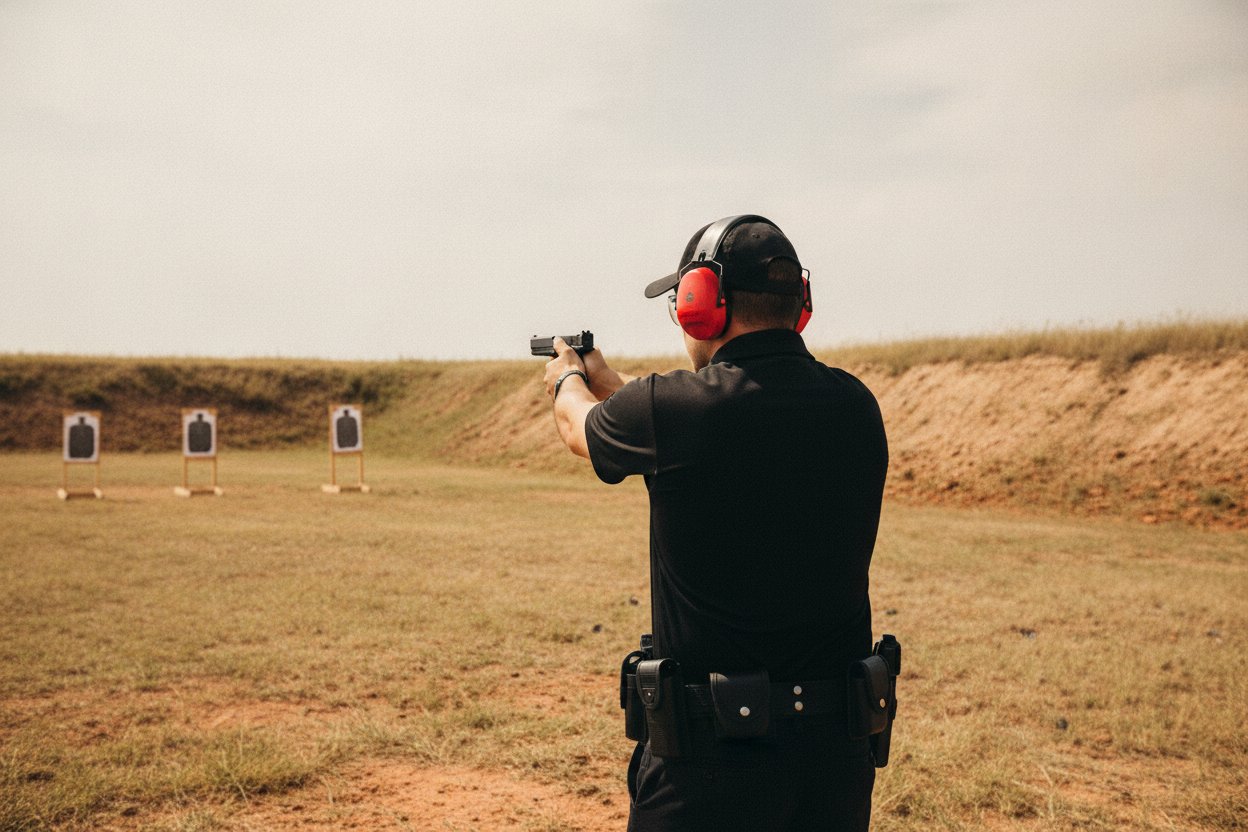
The firearms proficiency exam sits at the end of Part 2 of the Level 3 course, and the single most useful thing to know about it is that it is close to identical in format to the Texas License to Carry proficiency exam. That comparison does a lot of work. It tells you the test is a published, standardized course of fire rather than an instructor’s personal gauntlet. It tells you the distances and the scoring are known before you arrive. And it tells you that the state is measuring safe, deliberate, accurate shooting, not speed, not tactics, not anything you would see in a competition.
The authority for this is §35.145 of the Texas Administrative Code, which provides that the qualification may be conducted using the DPS Primary Issued Handgun Qualification Course or the DPS Approved LTC Course. Either one satisfies the requirement. If you want to see the language rather than take our word for it, it is public in 37 TAC Chapter 35.
The Shotgun Provision Nobody Mentions
One section further on, §35.146 establishes a shotgun course of fire for commissioned security officers. In practice that means students have the option to qualify with a shotgun in addition to a handgun. It is genuinely optional and the handgun qualification is the one that matters for the great majority of posts. But it exists in the rule, and officers who end up on industrial or high-value assignments in the DFW freight corridor sometimes find it useful to have on file rather than to arrange later.
Everything That Has to Happen Before You Reach the Line
Part 2 does not stand alone. The Level 3 course is built in two halves, and the range is the second of them. Part 1 is classroom material and East Texas Security Training Academy runs it 100% online: the law governing armed security work, use of force, the duties that attach to a commission, and a written examination. Part 2 is the in-person half, covering defensive tactics, firearms handling, and the firearms proficiency exam.
Because those halves are separate, so is what you pay for. The online course price covers the online training only, and the in-person firearms qualification is scheduled separately and is not included. There is no live fire anywhere in the online portion, which is worth stating plainly because the question comes up constantly.
There is also a restriction on who may teach any of it. The course material is prepared by and obtained from DPS, and Level 3 may only be delivered by a DPS-approved school using a DPS-approved instructor. That is a sharper rule than the one governing the Level 2 class, where a licensed company may use its own designee to train employees in-house. For Level 3, in-house delivery is simply not an option, regardless of the size of the company.
The Exam That Deserves More Respect Than It Gets
Under §35.144(c), the minimum passing grade on Level 3 school examinations is 75%. Set that next to the License to Carry written test and the difference is obvious: 75% is the higher bar. Students who breezed through LTC and expect a repeat are the ones who get caught out. The subject matter is not obscure, but it is dense in the places that matter most. When force may be used, what a commission authorizes and what it does not.
A related point of confusion: Level 3 is the commissioned security officer course and Level 4 is the personal protection officer course. Level 4 is the bodyguard credential, its own separate class with a minimum of fifteen classroom hours under §35.141(a)(3). Level 3 is not a lower rung of Level 4, and Level 4 is not a general advanced armed tier. §35.141(a)(2) requires Level 3 for a security officer commission and for personal protection officers, which is how the two ended up tangled in so many job postings.
From Certificate to Commission
Passing the range and the exam produces a certificate of completion, referred to on this site as PSP 30. Under §35.147, an approved school issues the original certificate to a qualifying student within seven days of qualifying and retains the training records for 24 months. Then comes the application, and this is where people lose time: §35.81(a) requires the application for a security officer commission to include copies of both the Level 2 and the Level 3 certificates, plus the other items DPS lists. Officers who threw away or lost their Level 2 certificate after starting work discover this at the worst moment. The commission itself is issued by DPS on that application. Finishing the class is the qualification, not the credential.
Why Grand Prairie Officers Go Armed
Grand Prairie sits right in the middle of the corridor between Dallas and Fort Worth, and the security work reflects that position: distribution and logistics operations, aerospace and manufacturing sites, entertainment and event venues that draw large crowds, retail centers, and the medical and banking posts that any city of this size supports. Commissioned postings are disproportionately concentrated in exactly those categories. High-value inventory, cash handling, restricted-access industrial property.
Because the commission belongs to the officer rather than to any one employer, it stays with you across the metroplex when contracts change, which they do. Keeping it current afterwards runs through the armed security renewal course, and the licensing side is handled by the Texas DPS Private Security Bureau. Our full class list and FAQ page will tell you which course fits where you are now.
Leave a Reply