When a Beaumont contract says “commissioned officer required,” it is naming a specific credential with a specific course behind it. That course is Level 3, and it runs in two parts.
Two Parts, One Credential
Part 1 is classroom material and it is delivered online: the law governing armed security work, use of force, the duties that attach to a commission, and a written examination. Part 2 is in person, and it is where defensive tactics, firearms handling and the firearms proficiency exam live. The online half never puts a firearm in your hands; that is deliberate, and it is the reason the two halves are scheduled independently of each other.
ETXSTA teaches Part 1 100% online. Be clear-eyed about the boundary: the online course price covers the online training only, and the in-person firearms qualification is scheduled separately and is not included. Two commitments, arranged to fit around each other rather than on top of each other.
Working Shifts on the Golden Triangle
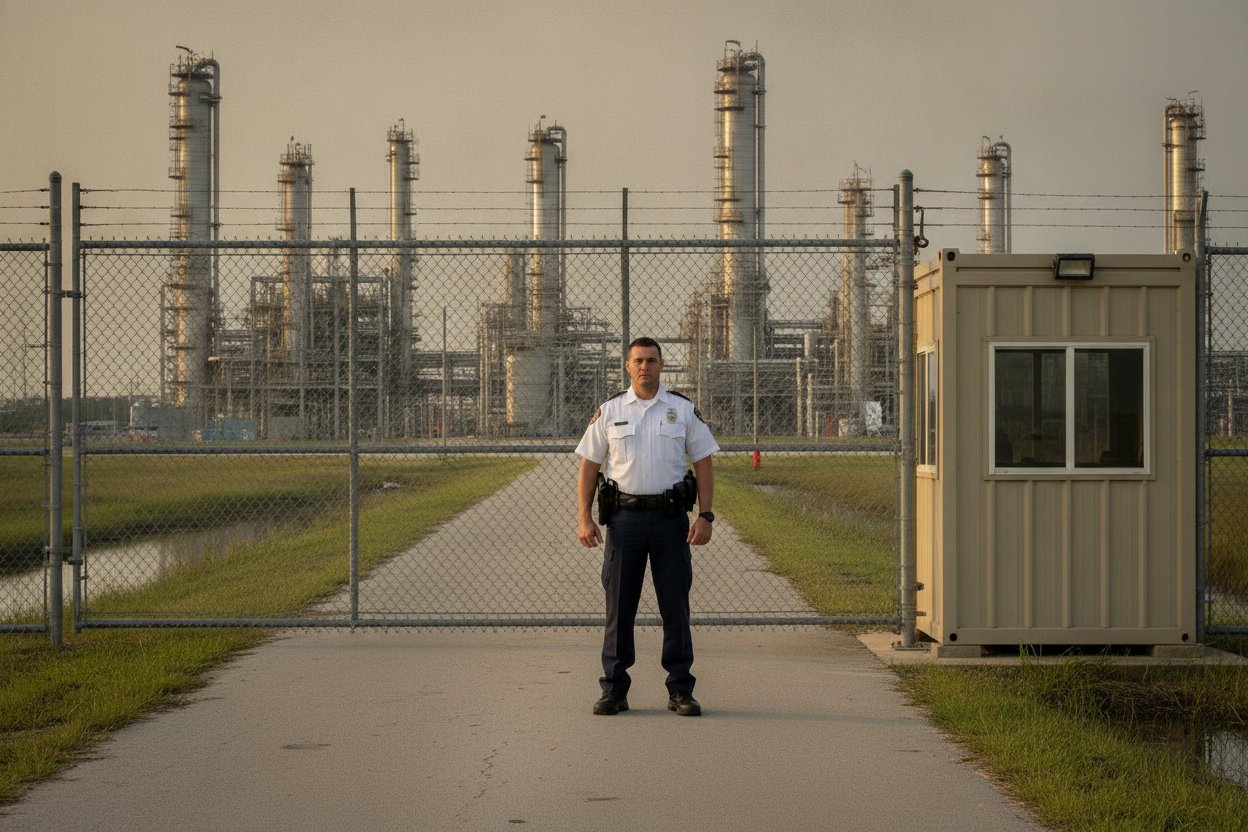
Beaumont is a shift town in a way that changes how training has to be delivered. The refining and petrochemical complex along the Neches, the port and terminal operations, the contractor traffic that swells during a turnaround, the hospital and campus posts in between. A lot of that armed coverage is twelve-hour rotations, and turnaround season does not care what week you had penciled in for class. Doing the classroom half asynchronously means a rotation change costs you nothing, because there is no seat you failed to show up for.
It also matters because plant-gate and terminal work is where a commission tends to pay for itself on the Gulf Coast. An officer holding both the unarmed and the armed credential is simply eligible for more of what is posted here.
What the Rule Requires
Under 37 TAC §35.141(a)(2), Level 3 training is required for anyone seeking a security officer commission, the credential permitting an officer to carry a firearm on duty, and for personal protection officers. That second group is where the common mix-up starts, so: Level 3 and Level 4 are different courses for different credentials. Level 3 is the commissioned security officer. Level 4 is the personal protection officer, the bodyguard credential, carrying a minimum of fifteen classroom hours under §35.141(a)(3). Nobody needs Level 4 to work an armed plant gate.
Level 3 is also tightly controlled at the delivery end. The course material is prepared by and obtained from DPS, and the course may only be taught by a DPS-approved school with a DPS-approved instructor. That distinguishes it from the Level 2 course, which a licensed company may run in house through its own designee. For Level 3, in-house delivery is not permitted at all, so if a contractor tells you they will handle your commissioning training on site, ask which approved school is behind it.
Passing, and What Passing Gets You
The minimum passing grade on Level 3 and Level 4 school examinations is 75% under §35.144(c). A higher bar than the written threshold on a License to Carry test, which catches out officers who expect the two to track each other. On the range, they track more closely: the firearms proficiency exam is close to identical in format to the Texas LTC proficiency exam, and §35.145 permits the qualification to be conducted using the DPS Primary Issued Handgun Qualification Course or the DPS Approved LTC Course. §35.146 separately sets out a shotgun course of fire for commissioned security officers, so qualifying with a shotgun alongside a handgun is available to you.
Passing produces a certificate of completion, PSP 30, and under §35.147 an approved school issues the original to a qualifying student within seven days of qualifying and keeps training records for 24 months. It does not produce the commission. Under §35.81(a), the application for a security officer commission requires copies of both the Level 2 and the Level 3 certificates plus the other items DPS lists, and DPS issues the commission on that application. Once it is in hand, the renewal course is what keeps it current.
Every rule cited here is readable in full at 37 TAC Chapter 35, and applications and license status sit with the Texas DPS Private Security Bureau. Our full course list shows how the three classes fit together.
Leave a Reply