
“Level 2 is the one where you shoot, right?” We hear that in Longview more than any other question about this course, and the answer is no: there is not a single round fired in it.
Clearing Up the Firearms Question First
Level 2 is the unarmed course. No firearms training and no firearms qualification is part of it: no range time, no weapon handling, nothing that touches a gun. Completing it does not allow you to carry a firearm on a post, and it does not by itself give you a commission.
The reason the rumor sticks around is that Level 2 is genuinely the doorway to the armed side. Under 37 TAC §35.141(a)(1) it is both the training required of anyone applying for a non-commissioned security officer license and the required first step toward a security officer commission. So people hear “it leads to carrying” and collapse two courses into one. The armed material lives in the Level 3 commissioned officer class, which comes after this one, not instead of it.
So What Is Actually in It
Course material prepared or approved by the Texas Department of Public Safety, covering Texas security law, the professional responsibilities of a security officer, emergency procedures, and ethics. That is the working knowledge of an unarmed post: what authority you have and where it stops, what you are obligated to do, how you handle an emergency and how you conduct yourself while doing it. At the end you receive a certificate of completion, PSP 36, which must be submitted with your license application to the Texas DPS Private Security Bureau.
The Other Thing Longview Gets Wrong: Who Can Teach It
Two opposite errors circulate on this one, and both cause problems. The first is “my supervisor said he’d take care of it,” meaning nothing formal will happen at all. The second is “it has to come from a school, so my company cannot possibly do it.”
The truth sits in between. Level 2 may be delivered either by the licensee’s own designated person or by a DPS-approved school with a DPS-approved instructor: that comes out of §35.141(a)(1) read alongside §35.142 and §35.143. The in-house route is legitimate when a company actually runs it. It is not a license to skip the course. And it is worth knowing that this flexibility is unique to Level 2. There is no in-house option for the commissioned course, which is a distinction that trips up officers moving up the ladder.
And No, It Does Not Need Continuing Education
Noncommissioned security officers are specifically exempt from continuing education requirements under §35.161(b). People assume otherwise because the commissioned side does carry CE and keeps it current through the renewal course. Unarmed officers are outside that. If you want to see it in the original, it is in 37 TAC Chapter 35.
This Is Our Home Ground
East Texas Security Training Academy is an East Texas school, and Longview is not an abstraction to us. Gregg County runs on the same things it has run on for generations. Oilfield service and pipe yards out toward Kilgore and Gladewater, industrial fabrication and manufacturing, the rail and trucking that moves all of it, and a hospital and clinic network that draws patients in from every small town in the region. Layer on the retail along Loop 281, the campuses, the apartment communities and the county and municipal buildings downtown among the red brick, and there is a real, steady base of unarmed security work here.
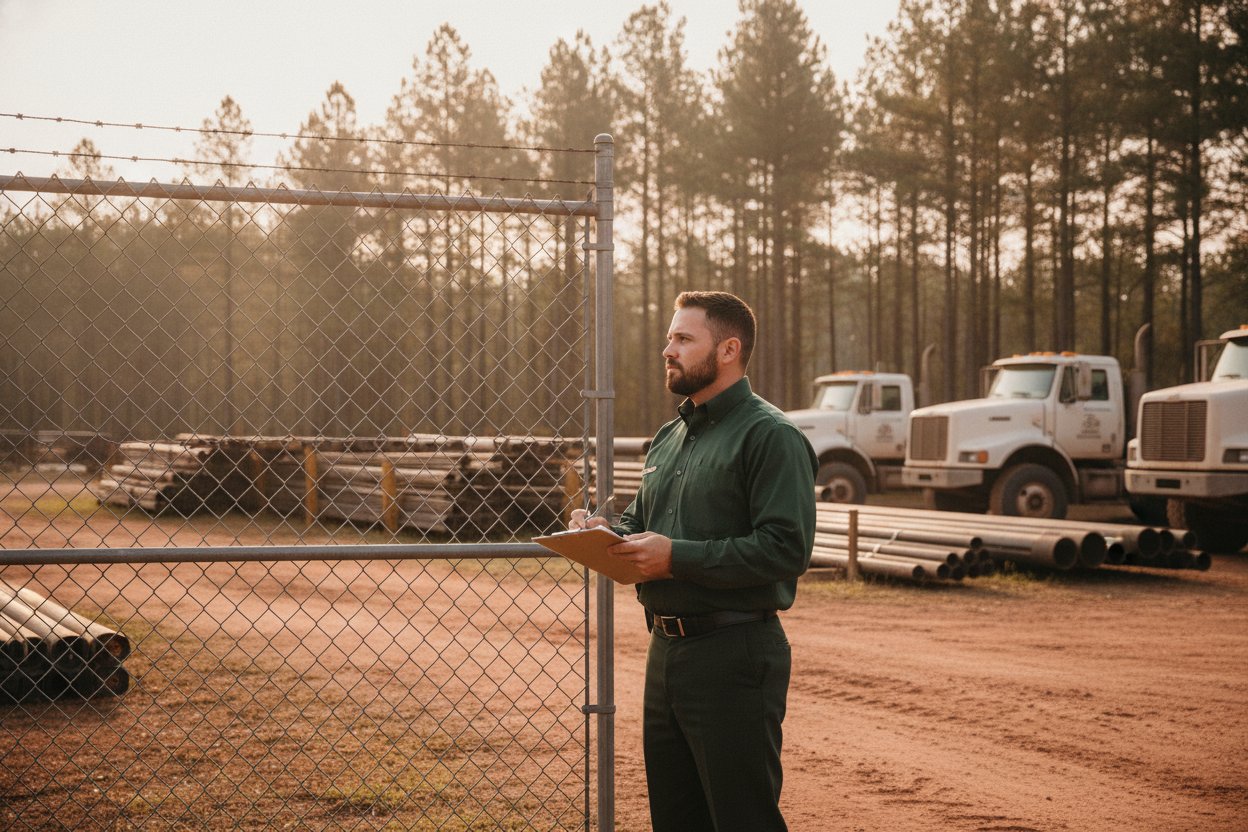
Most of those posts, the yard gate, the badge desk, the clinic lobby, the contractor check-in trailer, are exactly what a non-commissioned license is built for. And because Longview sits inside the Tyler–Marshall–Kilgore triangle rather than an hour outside a metro, an officer here can work across several towns on one credential without ever relocating.
We deliver Level 2 100% online, which for local officers means you are not burning a shift driving anywhere at all. If something here still does not square with what you were told on site, our FAQ page covers the usual sticking points, and the class list shows how Level 2, Level 3 and renewal fit together.
Leave a Reply