
How long does renewal take? Honestly, that depends less on the six hours of coursework than on how quickly you get to a range: which is the piece of this that an online class has never been able to include.
Begin with what we cannot sell you
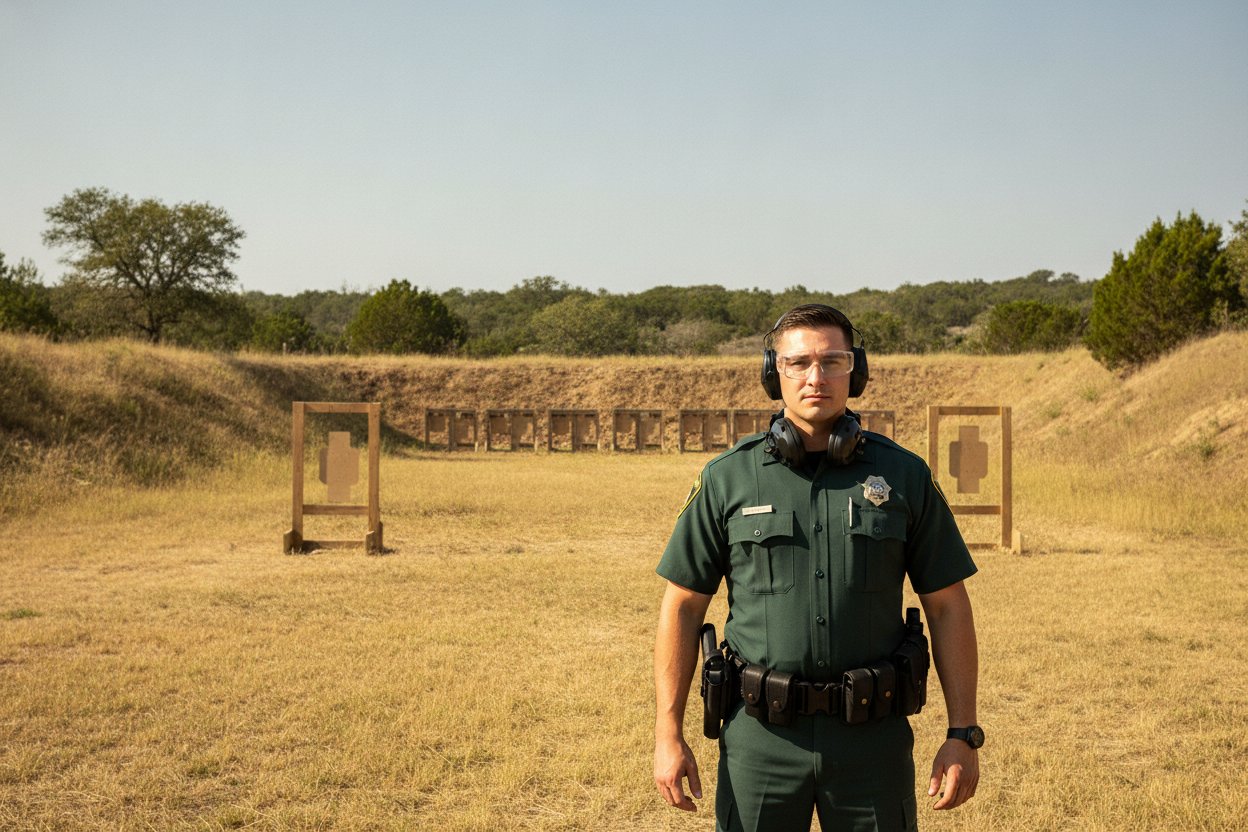
Most articles about renewal save the caveats for the bottom. We would rather lead with them, because it is the part that determines your timeline. The price of our online course covers the online training only. The in-person firearms qualification is not included, and it is scheduled separately once you have finished the online portion. That is not a policy we chose for convenience. Proficiency with a firearm is demonstrated in person, and the renewal file reflects it: §35.161(g) states that a commissioned security officer must submit a firearms proficiency certificate with the renewal application.
If a shotgun sits on your authorization, there is a second live-fire item to put on the same calendar. §35.146(b) establishes a biennial familiarization of six rounds of “00” buckshot in connection with renewal of a commissioned security officer: a small requirement in volume, but one that only exists on a range, and one that is tied directly to renewal rather than floating loose somewhere in your training history.
Now the half that is genuinely covered
What you are buying is the classroom requirement in full: the six hours of continuing education that §35.161(g) imposes on commissioned security officers and personal protection officers, earned as the rule directs, by completing the renewal portions of the Level III or IV training course, as applicable, and delivered 100% online from beginning to end, finishing with the certificate of completion this site calls PSP 31. No classroom day, no travel, no fixed start time.
There is one non-negotiable attached to those hours. §35.161(g) requires the continuing education to be taught by department-approved training schools and instructors, and the neighboring rules make that exclusive rather than preferred. Under §35.162(d), the in-house continuing education exemption that companies with ten or more licensed employees may use does not apply to commissioned security officers or personal protection officers. Under §35.162(f), continuing education credits earned through outside entities may not be used to satisfy their requirement. For an armed officer, those two together leave exactly one lawful source of CE hours, and an employer safety day is not it.
The clock runs backwards from your expiration date
Timing is the other half of the “how long does this take” question, and §35.161(n) answers it in a way people routinely paraphrase wrong. Continuing education is valid only if completed within the two-year period preceding the license’s current expiration date. It is a window anchored to your expiration, not a habit of taking a class every couple of years, and hours completed outside it simply do not count toward the renewal in front of you. Pair that with §35.161(a), which prevents a renewal application from being submitted at all until the required minimum hours are earned, and the practical sequence is fixed: hours, then qualification, then filing.
Waco officers are usually driving somewhere anyway
Waco sits roughly halfway between the Metroplex and Austin on I‑35, which shapes the local security market in a specific way: manufacturing and food-processing plants, distribution and warehousing built around that corridor, a large university and its surrounding student housing, hospital and clinic campuses, and a downtown and riverfront that draw far more visitor traffic than a city this size would otherwise generate. Plenty of armed posts, but not a dense cluster of training providers, so officers here are used to treating training as a trip. Cutting the classroom half out of that trip list is the whole point of an online course. It leaves you one drive to plan, for the one requirement that genuinely has to be done in person.
Paper, and who holds it
Three obligations run in parallel after you finish. §35.161(a) puts proof of completion in the employer’s hands, maintained in the employee’s personnel file, with the licensee indicating completion on the renewal application. §35.161(m) puts a duty on you personally: keep certificates of completion for two years and furnish copies to the department on request. And §35.162(b)(3) defines what the certificate itself has to show, namely your name and license number, the date of attendance, the number of hours and the courses attended, signed and dated by the school director, with the school holding records for two years. If you change employers mid-cycle, note which of those three follows the job and which follows you.
Make sure this is your class at all
Unarmed officers can stop reading: §35.161(b) exempts noncommissioned security officers from continuing education, so a Level 2 non-commissioned license carries no CE burden of this kind. At the other end, §35.141(d) requires an inactive or expired licensee who has not been employed in the industry for three years or more to submit current training certificates to the department. If that describes you, the complete Level 3 commissioned officer course is more likely to be what you need than a six-hour renewal. Military service members should also know about §35.182, which allows two additional years to complete a continuing education or other renewal-related requirement, alongside §35.181’s waiver of late-renewal penalty fees.
One clarification worth making because the industry blurs it: Level 3 is the commissioned security officer and Level 4 is the personal protection officer. Distinct credentials, distinct jobs, one shared renewal pathway through the renewal portion of each course. The rules are published as 37 TAC Chapter 35, licensing runs through the Texas DPS Private Security Bureau, and if your circumstances do not match anything described here, start with our frequently asked questions or look through every class we offer.
Leave a Reply