
Renewal is less a task than a schedule. For an El Paso commissioned officer, knowing which months your continuing education is allowed to happen in is worth more than knowing what is taught in it.
When Does the Clock Actually Start?
It starts two years before your license expires, and it is measured backward from that date rather than forward from anything you have already done. §35.161(n) states that continuing education is only valid if completed within the two-year period preceding the license’s current expiration date. So the starting point is not your last class, not your hire date and not your firearms qualification. It is the expiration date on the commission in your wallet.
What Happens If You Train Too Early?
The hours do not count, and you take them again. That is a blunt answer, but it is the whole answer. The rule describes a window of validity, not a recurring interval, which is why “you have to renew every two years” is a phrasing worth dropping. An interval implies that any class spaced roughly two years from the last one is fine. A validity window implies something stricter: the class either sits inside the twenty-four months before your expiration date or it is outside the requirement, regardless of how recently you took it or how good the instruction was.
The officers most likely to get caught are the organized ones. People who finish training the moment it occurs to them rather than the moment it becomes valid. If you are not sure where your window sits, check your expiration date before you enroll in anything.
Why El Paso Officers Feel the Deadline Differently
El Paso sits a long way from the rest of Texas, and that geography changes what a late renewal costs you. Elsewhere in the state an officer who realizes in month twenty-three that the hours are not done can usually find a classroom seat somewhere within an hour’s drive. Out here the nearest comparable metro is most of a day’s driving away, so a missed window is not a minor inconvenience. It is a genuine logistics problem.
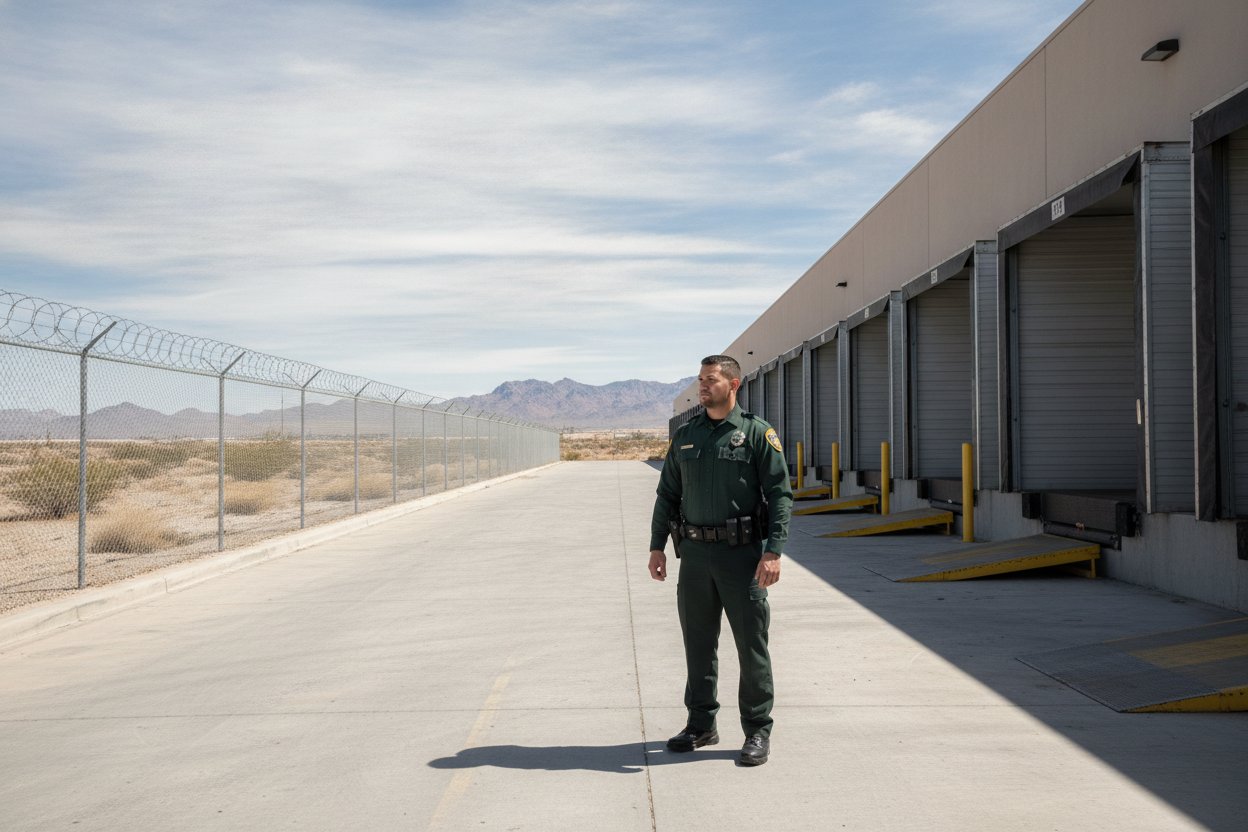
The local demand for armed posts is real and it is unusually concentrated in logistics. Cross-border freight and customs brokerage feed a dense belt of warehousing, transloading yards and truck terminals on the east and northeast sides of the city, and those sites run on shift patterns that do not respect weekends. Layer on the hospital and medical center campuses, the retail and shopping corridors, utility and industrial sites, and the steady contracting activity that comes with a large military installation next door, and you get a workforce of armed officers whose free hours are scattered across nights and rotating days. Six hours of classroom time is genuinely hard to find here.
That is the case for taking the classroom portion 100% online. It removes the drive entirely and lets the six hours fit into whatever gaps your rotation leaves. Budget for the part that is not online: the price covers the online training only, and the in-person firearms qualification is not included: it is scheduled separately after you finish the online course.
What Has to Be Done Before the Application Moves?
- The six hours of continuing education required by §35.161(g), earned inside your valid window through the renewal portion of the Level 3 or Level 4 course as applicable.
- Your firearms proficiency. A commissioned security officer must submit a firearms proficiency certificate with the renewal application.
- Only then the application itself. §35.161(a) is explicit that a renewal application may not be submitted until the required minimum hours have been earned.
- Proof maintained by your employer in your personnel file, with completion indicated on the renewal application by you.
Afterward the recordkeeping stays with you. Your certificate is issued as PSP 31, and §35.161(m) requires attendees to keep certificates of completion for two years and furnish copies to the department on request. Under §35.162(b)(3) the certificate itself carries your name and license number, the date of attendance, the hours and the courses attended, signed by the school director.
Who Is Allowed to Give You Those Hours?
Only a department-approved school. §35.161(g) requires the continuing education to be taught by department-approved training schools and instructors, and the two obvious workarounds are closed by name: §35.162(d) confirms the in-house continuing education exemption for companies with ten or more licensed employees does not apply to commissioned security officers or personal protection officers, and §35.162(f) confirms credits earned through outside entities may not be used to satisfy their requirement. If you want to see the wording yourself it is in 37 TAC Chapter 35, and licensing is administered by the Texas DPS Private Security Bureau.
Whose Calendar Looks Different?
Military service members. §35.182 grants two additional years to complete a continuing education requirement or any other renewal-related requirement, and §35.181 waives late-renewal penalty fees for them. In a city with this much military connection, that provision is worth knowing before you assume a commission is gone.
Officers who left the industry. §35.141(d) requires someone inactive or expired who has not been employed in the industry for three years or more to submit current training certificates to the department. If that describes you, the full Level 3 course is more likely to be your route than the renewal.
Unarmed officers. §35.161(b) exempts noncommissioned security officers from continuing education, so a Level 2 license carries none of these dates. And keep the two commissioned-side credentials straight: Level 3 is the commissioned security officer, Level 4 is the personal protection officer, and they are separate licenses that happen to share a renewal pathway. Our FAQ page handles the borderline cases.
Leave a Reply