
“My company runs its own training, so my continuing education is handled.” It is the single most common thing Carrollton officers get wrong about renewal, and the rule that contradicts it is short enough to read in one sitting.
The In-House Exemption Exists — It Just Does Not Cover You
The reason this misunderstanding is so durable is that the exemption is real. Companies with ten or more licensed employees do have an in-house continuing education route available to them, and if you have worked a few different contracts around the Metroplex you have probably heard a supervisor mention it. The catch sits in §35.162(d), which states plainly that the in-house exemption does not apply to commissioned security officers or personal protection officers. Whatever your employer runs internally, it does not discharge your obligation if you carry a commission.
A companion provision closes the other obvious side door. Under §35.162(f), continuing education credits earned through outside entities may not be used to satisfy the requirement for commissioned security officers or personal protection officers either. Put the two together and the picture is unusually clean: an armed officer’s hours come from a department-approved training school, and from nowhere else.
So What Does the Rule Ask For?
§35.161(g) sets the substance. Commissioned security officers and personal protection officers complete six hours of continuing education, and they satisfy that requirement by completing the renewal portions of the Level III or IV training course, as applicable. The same subsection requires the continuing education to be taught by department-approved training schools and instructors, and it requires a commissioned security officer to submit a firearms proficiency certificate with the renewal application.
Timing has its own rule, and it is worth stating precisely rather than in the usual shorthand. §35.161(n) provides that continuing education is only valid if it was completed within the two-year period preceding the license’s current expiration date. That is a validity window rather than a renewal interval — hours taken outside it simply do not count. And §35.161(a) adds that a renewal application may not be submitted until the required minimum hours have been earned, with proof maintained by the employer in your personnel file and completion indicated by you on the application itself.
Two Credentials, One Renewal Path
Because §35.161(g) names both, this course serves two different licenses. Level 3 is the commissioned security officer, the credential that authorizes carrying a firearm on post. Level 4 is the personal protection officer — the bodyguard credential — which is a separate qualification rather than a higher rung of the commissioned ladder. Plenty of Texas job listings blur the two into one phrase. They are distinct licenses that happen to share a renewal pathway, each pointing to the renewal portion of its own course.
And if you are unarmed, you can stop reading with relief. §35.161(b) exempts noncommissioned security officers from continuing education altogether, so an officer working on a Level 2 non-commissioned license has no CE obligation to satisfy at all.
Carrollton Realities
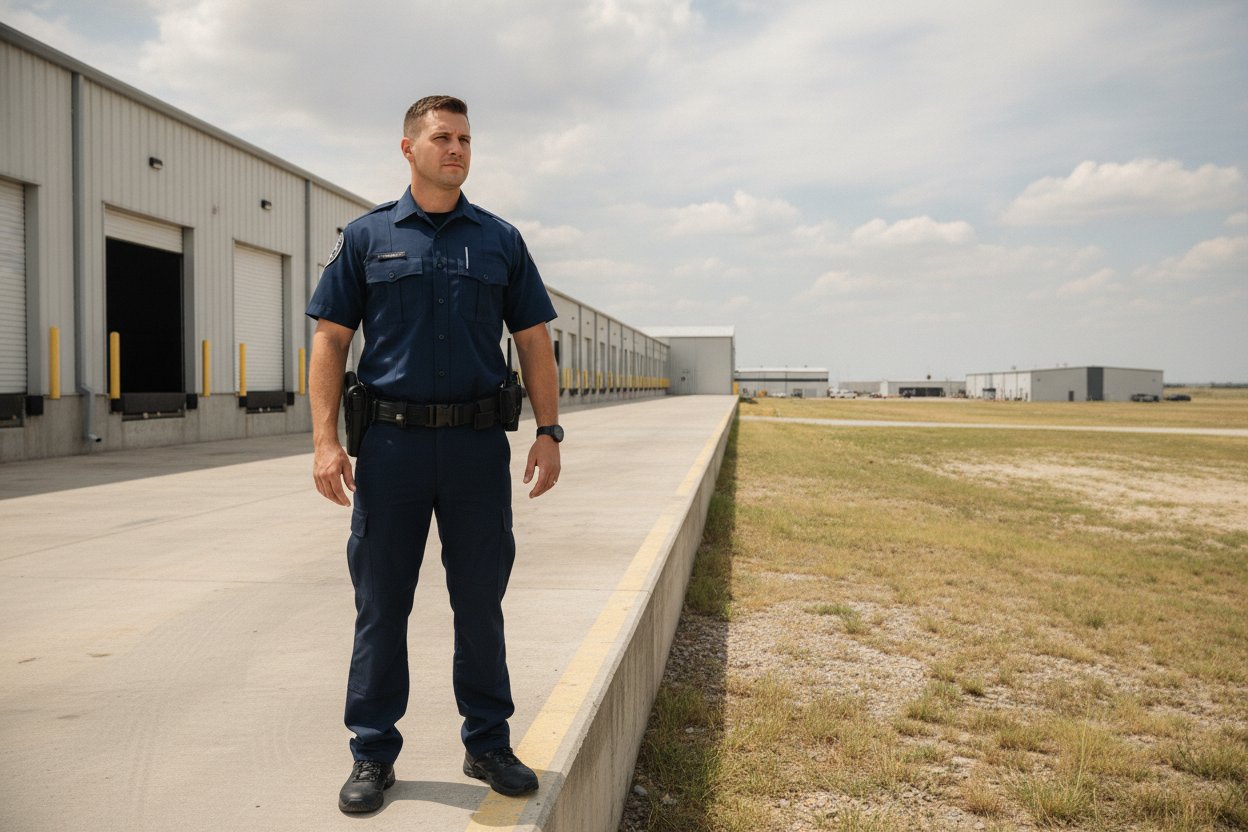
Carrollton sits in the thick of the north Metroplex’s warehousing and light-manufacturing belt, and that shapes the kind of armed work available here: distribution facilities, freight and logistics yards, office parks along the tollway corridors, and contract posts that rotate an officer between sites in several neighbouring suburbs over the course of a year. That rotation is exactly why the in-house myth causes trouble — officers assume whichever company currently holds the contract is tracking their hours. The commission belongs to you, not to the contract, and so does the renewal obligation.
The practical upside is that the classroom half runs 100% online, so six hours fits around a rotating schedule without a drive. Do note what the online enrollment covers: the online training only. The in-person firearms qualification is not included and is arranged separately once the online portion is behind you. You finish with a certificate of completion, referred to on our site as PSP 31.
Recordkeeping the rule puts on you
- §35.161(m): you keep your certificate of completion for two years and furnish copies to the department on request.
- §35.162(b)(3): the school’s certificate of attendance shows your name and license number, the date of attendance, the number of hours and the courses attended, signed and dated by the school director. The school retains its records for two years.
- §35.161(a): your employer maintains proof in your personnel file — but that is in addition to your own copy, not instead of it.
Before You Enroll
If you have been out of the industry for a stretch, check your footing first. §35.141(d) provides that someone inactive or expired who has not been employed in the industry for three years or more must submit current training certificates to the department, which may mean the full Level 3 commissioned course rather than the renewal. Service members have room the rule grants specifically: §35.182 allows two additional years to complete a continuing education or other renewal-related requirement, and §35.181 waives late-renewal penalty fees for military service members.
The full text is public — read 37 TAC Chapter 35 for yourself, and the Texas DPS Private Security Bureau handles the licensing side. Our FAQ page answers the questions that come up most often from Carrollton officers.
Leave a Reply