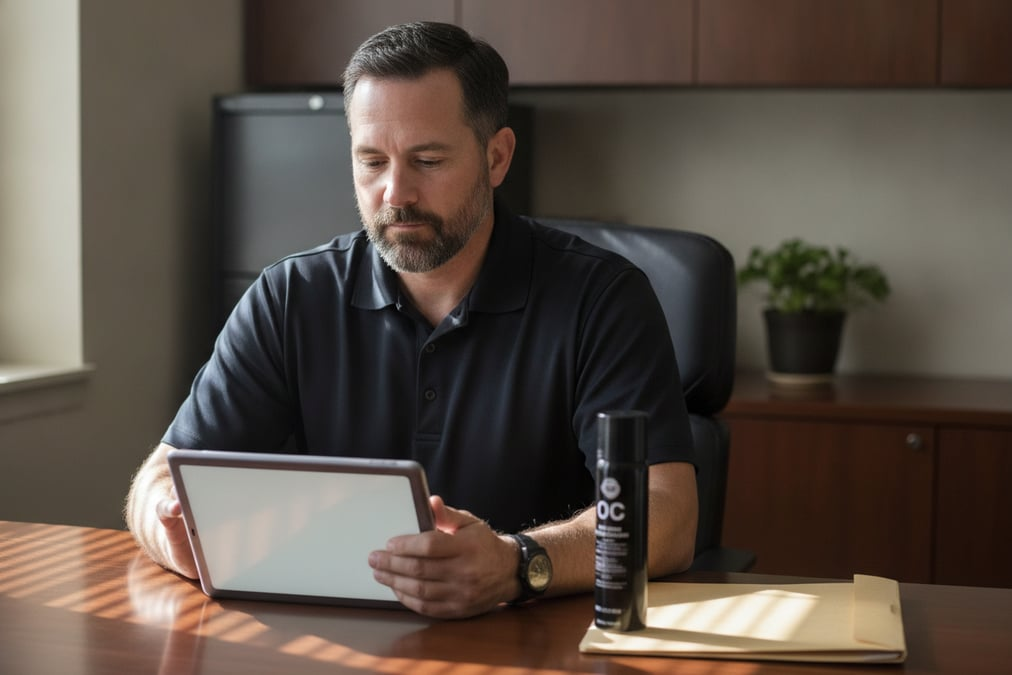
Security work does not leave much room in a week. Officers pull twelve hour shifts, rotate days and nights, and drive an hour to a post. Asking someone on that schedule to give up a full weekday for classroom instruction is asking a lot. That is the problem the online portion of ETXSTA’s OC pepper spray course solves. The classroom material moves to a screen, on your schedule, and the only thing left that needs a room and an instructor is the part that genuinely needs them.
Check one thing before you enroll
Texas DPS approved the pepper spray training as a supplement to the Level III curricula, and states it is “therefore approved only for those who have successfully completed the Level III training.” The reason DPS gives is that the defensive tactics and use of force components of Level 3 provide the background needed for an officer’s use of the device to be safe, appropriate, and authorized.
So finish Level 3 first. Officers who have already completed it do not repeat it to add OC.
How the online portion works
You enroll, you get access, and you start. There is no cohort to wait for and no fixed start date.
- Self-paced. Work through it in one sitting or in twenty minute pieces between shifts.
- Any device with a browser. Phone, tablet, laptop, or the desktop at the front desk on a slow overnight, as long as your supervisor is fine with it.
- Your place is saved. Close the tab, come back the next day, pick up where you stopped.
- Reviewable. If the section on distance or decontamination did not land the first time, go back through it. Nobody is waiting on you.
What the online portion teaches
Most of what makes an officer safe with OC is decision making, and decision making is knowledge. That is what moves online well.
You learn what oleoresin capsicum is and what it does to a human body, including why two people hit with the same burst can react completely differently. You learn where OC sits among an officer’s force options and what level of resistance makes it a reasonable choice. You learn why minimum and maximum distance both matter, what a proper burst looks like, why a verbal warning comes first when the situation allows one, and why the canister you have carried for two years still needs to be checked.
Then you learn what happens after the spray, which is the half of this subject officers underestimate. Getting a subject into fresh air and cool water. Removing contaminated clothing. Why creams and ointments make it worse. Why contact lenses are left to medical personnel. Why you keep watching the person instead of turning your back once they stop fighting, what pre-existing conditions raise the risk, and which warning signs mean you call EMS right now and do not wait to see if it passes. You also learn where liability comes from, which is rarely the spray itself and usually the decision to use it, the amount used, or the care that was not given afterward.
All of this is material you can read, review, and be tested on. Sitting in a chair in a classroom does not make you learn it better. Being able to go back over it twice does.
What the online portion cannot teach
We will be straight about this, because a school that pretends otherwise is doing its students harm. Online instruction cannot teach your hands anything.
Getting the canister out of a carrier while a subject is closing distance is a physical skill. So is keeping it oriented the right way under stress, holding a pattern on a moving target, judging three feet from fifteen feet with your eyes instead of a diagram, and going through decontamination as a hands-on procedure rather than a list of steps.
So the in-person session is not a formality bolted onto the end. It is the half of the course that makes the online half usable on a post. It is scheduled separately from your online enrollment, on its own calendar, which you can see on the class schedule. Plan for both parts from the beginning rather than finishing Part 1 and discovering the timing is tight.
Why the certificate matters to an employer
An employer’s position on OC is simple. If an officer on their contract sprays somebody, that company will be asked what training the officer had. The answer needs to be a document with a name, a date, and a school on it, not a supervisor’s recollection that the officer seemed to know what he was doing.
That is what your certificate does. It is evidence that you were taught the deployment standards and the aftercare protocol, on a specific date, by an approved school. It goes in your personnel file, it comes up when your company bids a contract that requires OC on the post, and it comes up again when you change employers. It is issued separately from your Level 3 certificate, so keep both, and keep your own copies rather than relying on an old employer to still have them.
Officers who are also working on a renewal or another level can see everything we offer on the course list, and more training articles are on the blog. If you are unsure which course you need next, our FAQ page covers the common cases and you can always reach out.
Leave a Reply