
Almost every Garland officer who calls about the Level 3 course asks the same question first, and it is never about the classroom. It is about the range — what the shooting test actually looks like, and whether they can pass it.
Start With the Range, Because That Is What You Are Worried About
Here is the reassuring part. If you have ever taken the Texas License to Carry proficiency test, you have already seen something very close to the Level 3 firearms proficiency exam. The format is close to identical. This is not a tactical audition, it is not a timed competition course, and nobody is trying to wash you out. It is a structured demonstration that you can put rounds where you intend to put them, at set distances, under a set of rules that are published in advance rather than invented on the day.
Those rules live in §35.145 of the Texas Administrative Code. The qualification may be conducted using either the DPS Primary Issued Handgun Qualification Course or the DPS Approved LTC Course. Both are recognised; neither is a secret. You can read the chapter for yourself at 37 TAC Chapter 35 before you ever pick up a firearm in class.
The Shotgun You Probably Did Not Know About
§35.146 sets out a separate shotgun course of fire for commissioned security officers. That means qualifying with a shotgun is available as an option in addition to the handgun, not a replacement for it. Most officers never exercise it. If you are looking at industrial or high-value posts where a long gun may be part of the site plan, it is worth knowing the option exists in the rule rather than finding out from a supervisor later.
Working Backward to Part 1
The range work is Part 2. It comes second for a reason. Part 1 is the classroom half, and East Texas Security Training Academy delivers it 100% online. It covers the law that governs armed security work, use of force, the duties that attach to a commission, and the written examination. The logic of the sequence is simple: the state would rather you understand when you may act before you demonstrate that you can.
Part 2 is in person and covers defensive tactics, firearms handling, and the firearms proficiency exam. Two practical notes Garland students should register now: the online course price covers the online training only, and the in-person firearms qualification is scheduled separately and is not included. Nothing in the online portion involves live fire.
One more thing about who may teach this. Course material is prepared by and obtained from DPS, and Level 3 may only be delivered by a DPS-approved school using a DPS-approved instructor. That is a real difference from the Level 2 course, where a licensed company can use its own designee in-house. For Level 3 there is no in-house shortcut, no matter how large the employer.
Seventy-Five, Not Seventy
The written exam has a minimum passing grade of 75% under §35.144(c). People who have been through the License to Carry process sometimes assume the threshold carries over. It does not — 75% is a higher bar than the LTC written test. It is not a hard number to hit if you actually work the material, but it is the number that catches the students who skim.
While we are clearing up confusions: Level 3 is the commissioned security officer course. Level 4 is the personal protection officer credential — the bodyguard course, a separate class with a minimum of fifteen classroom hours under §35.141(a)(3). They are not grades of the same licence. Under §35.141(a)(2), Level 3 is required both for a security officer commission and for personal protection officers, which is why the two get mixed up, but you do not take Level 4 to become an armed guard.
The Paperwork Half
- Under §35.81(a), the application for a security officer commission requires copies of both your Level 2 and your Level 3 certificates of completion, along with the other items DPS lists. Keep the Level 2 certificate — it does not become obsolete.
- The certificate of completion is referred to on this site as PSP 30.
- Under §35.147, an approved school issues the original certificate to a qualifying student within seven days of qualifying, and retains training records for 24 months.
- Completing Level 3 is not the same as holding a commission. The commission is issued by DPS on application — the course and the qualification are what make the application possible.
Why This Comes Up So Often in Garland
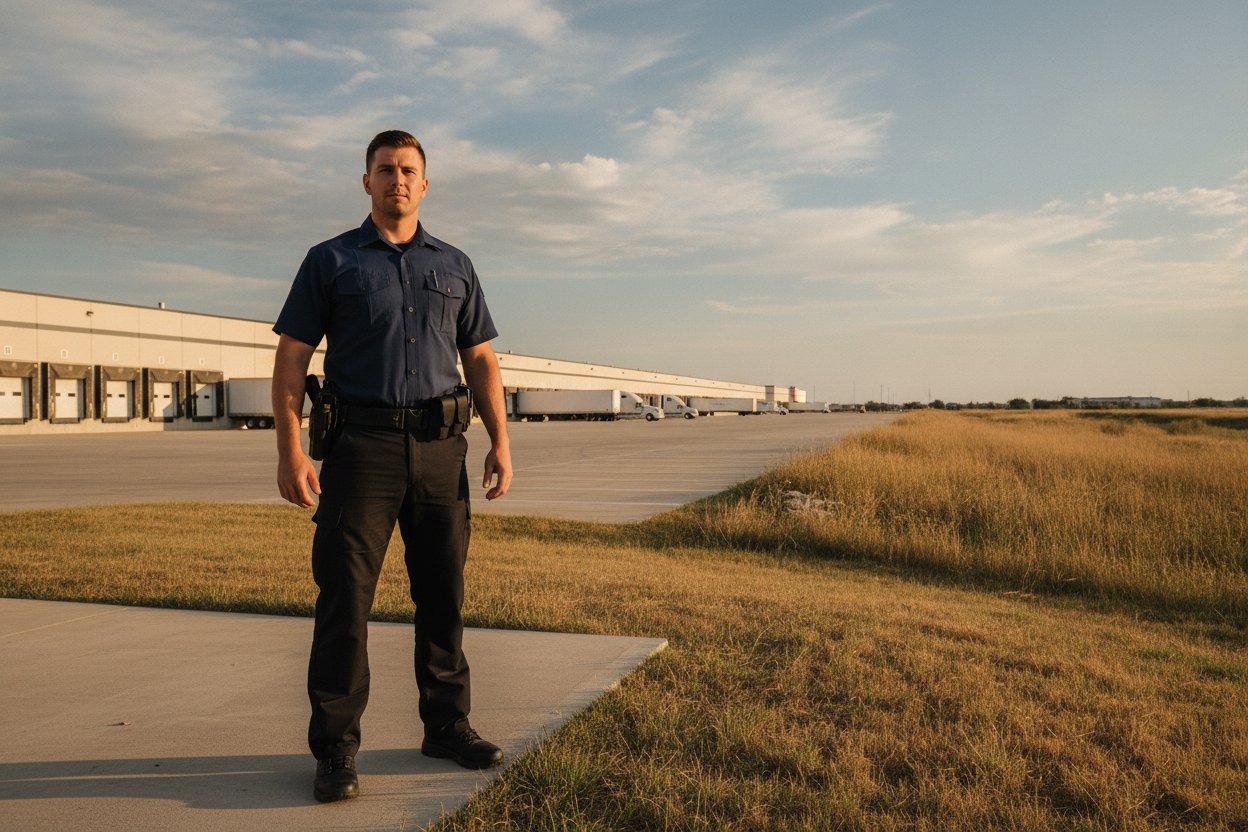
Garland sits on the industrial side of the Dallas–Fort Worth metroplex, with a manufacturing base and a heavy concentration of warehousing and distribution operations feeding the wider North Texas freight network. That mix produces exactly the kind of armed posts a commission opens up — industrial plant gates, distribution hubs, equipment yards, and the medical and banking contracts that follow any city this size. The pattern most Garland officers describe is the same: they start unarmed, they notice that the commissioned postings pay differently and schedule differently, and they come back for Level 3.
Once the commission is in hand, keeping it current is a separate obligation handled through the armed security renewal course. Licensing itself runs through the Texas DPS Private Security Bureau. If your situation is unusual — a lapsed licence, an out-of-state background, a question about sequencing — check our FAQ page or the full list of classes before you enrol in the wrong thing.
Leave a Reply