
A misconception worth clearing up before you enroll: an online renewal course in Texas does not qualify you with a firearm. It was never able to, and no school in the state can sell you one that does.
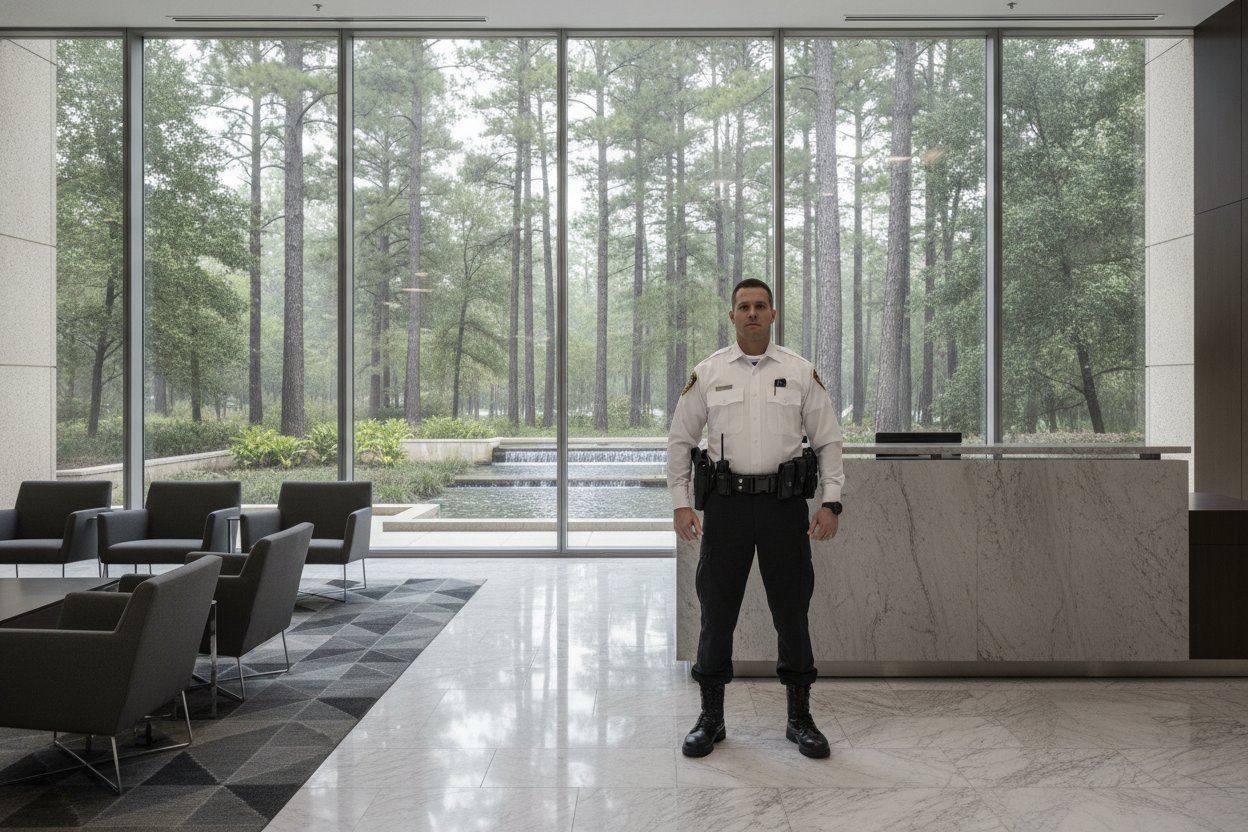
Officers in The Woodlands ask about this constantly, usually a few weeks before an expiration date. So rather than describe the course in the abstract, here it is as an itemised list. What an enrollment buys, and what it pointedly does not.
Inside the enrollment
All six continuing education hours
§35.161(g) obliges commissioned security officers and personal protection officers to complete six hours of continuing education, and it defines how: by completing the renewal portions of the Level III or IV training course, as applicable. Every one of those hours runs 100% online here, on your own schedule.
Delivery by an approved school, which is mandatory, not a selling point
The same subsection requires that the continuing education be taught by department-approved training schools and instructors, and two neighboring rules make sure there is no side door. §35.162(d): the in-house CE exemption for companies with ten or more licensed employees does not apply to commissioned security officers or personal protection officers. §35.162(f): outside-entity CE credits may not be used for them. Whatever else your employer’s training calendar does for you, it does not produce these six hours.
A certificate that meets the description in the rule
You finish with the certificate of completion identified on this site as PSP 31. §35.162(b)(3) specifies its contents, attendee name and license number, date of attendance, number of hours, courses attended, signed and dated by the school director, and the school keeps its own records for two years.
Outside the enrollment
The firearms qualification
What you pay covers the online training only. The in-person firearms qualification is not included and must be scheduled separately once the online portion is complete. This is the item that closes out your file: §35.161(g) states that a commissioned security officer must submit a firearms proficiency certificate with the renewal application. No certificate, no complete application. However many CE hours you have banked.
Shotgun familiarization, where it applies
§35.146(b) sets a biennial familiarization of six rounds of “00” buckshot in connection with renewal of a commissioned security officer. Another live-fire item, another thing an online classroom cannot stand in for.
Filing, and the order it has to happen in
We do not file for you, and under §35.161(a) nobody can file early: a renewal application may not be submitted until the required minimum hours have been earned. Proof is maintained by the employer in the employee’s personnel file, and you indicate completion on the application. Separately, §35.161(m) puts the two-year retention duty on you. Hold your certificates of completion and furnish copies to the department on request.
Fitting six hours into a Woodlands rotation
The Woodlands runs on corporate campuses, energy-sector office towers, medical buildings and a large retail and entertainment core, with residential and gated-community work threaded through the pine belt around them. A lot of fixed, uniformed, long-shift posts. The commute south into Houston for a classroom day is the sort of thing officers put off until the deadline is uncomfortably close. Taking the classroom half online leaves you one appointment to book instead of two, and it is the appointment the rules will never let you skip.
Four details that catch people out
- Timing. §35.161(n) makes CE valid only if completed within the two-year period preceding the license’s current expiration date: a window measured back from expiration, not a rolling habit.
- Unarmed officers are exempt. §35.161(b) excuses noncommissioned security officers from CE entirely; Level 2 training follows its own path.
- Long lapses change the answer. §35.141(d) requires an inactive or expired licensee out of the industry for three years or more to submit current training certificates. Usually meaning the complete Level 3 commissioned course, not this renewal.
- Service members get room. §35.182 grants two additional years for a CE or other renewal-related requirement, and §35.181 waives late-renewal penalty fees for military service members.
Finally, the pairing this renewal serves: Level 3 is the commissioned security officer and Level 4 is the personal protection officer. Two credentials, one renewal route, and Level 4 is not a step up from Level 3. The governing text is Chapter 35 of the Texas Administrative Code, the licensing authority is the Private Security Bureau at Texas DPS, and our full course list shows what else we run.
Leave a Reply