
Ask ten armed officers on the Coastal Bend how renewal works and most will tell you the same thing: you renew every two years. It is a reasonable summary and it is not the rule: and officers lose completed hours to the difference every year.
A Window, Not an Interval
Here is the actual text of the timing rule. §35.161(n) provides that continuing education is only valid if completed within the two-year period preceding the license’s current expiration date. Read that carefully, because it describes something different from a renewal schedule. It is a window measured backward from your expiration date, and it tells you which hours count, not how often you must act.
The practical consequence is the part worth internalising. Hours completed outside that window do not count toward the renewal in front of you, no matter how legitimate the class, how approved the school or how carefully you kept the paperwork. An officer who takes a course well ahead of the window, thinking of it as getting organized early, can arrive at the expiration date with nothing usable. The fix is unglamorous: check the expiration date printed on your license first, and work backward from it before you enroll in anything.
A second timing rule works in the opposite direction. §35.161(a) states that a renewal application may not be submitted until the required minimum continuing education hours have been earned. So the hours cannot be too early, and the application cannot come before the hours. The sequence has only one correct order.
The Hours Themselves
Under §35.161(g), commissioned security officers and personal protection officers complete six hours of continuing education, satisfied by completing the renewal portions of the Level III or IV training course, as applicable. That continuing education must be taught by department-approved training schools and instructors, and a commissioned security officer must submit a firearms proficiency certificate with the renewal application.
Two provisions rule out the shortcuts officers most often ask about. §35.162(d) states the in-house continuing education exemption for companies with ten or more licensed employees does not apply to commissioned security officers or personal protection officers, and §35.162(f) states that credits earned through outside entities may not be used for them. If you are armed, your six hours come from an approved school.
Officers who carry a shotgun on post have one extra item to track. §35.146(b) sets a biennial familiarization of six rounds of “00” buckshot in connection with renewal of a commissioned security officer. It applies in the shotgun context specifically, and it is easy to overlook until a supervisor asks for it.
Which License Are We Talking About?
This one course serves two credentials because §35.161(g) names both, but they are genuinely separate. Level 3 is the commissioned security officer. Level 4 is the personal protection officer, the bodyguard credential, with its own course, and not a senior version of a commission. Each renews through the renewal portion of its own course. Meanwhile §35.161(b) exempts noncommissioned officers from continuing education entirely, so an unarmed officer on a Level 2 license has nothing to complete here.
Renewing From the Coastal Bend
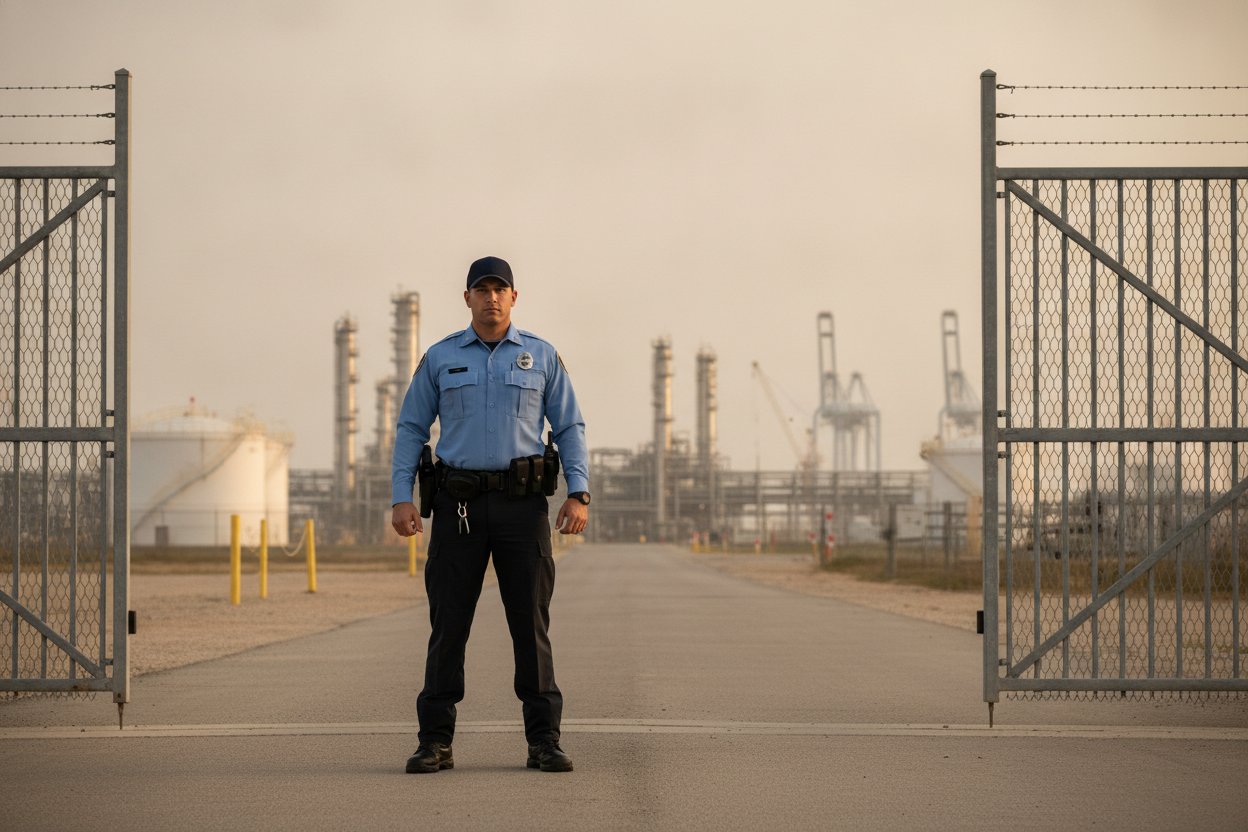
Corpus Christi runs on industry that takes access control seriously: port and terminal operations, refining and petrochemical facilities along the ship channel, energy infrastructure, plus the hospitals, campuses and retail corridors of a city that serves a wide rural catchment. Armed posts here frequently sit inside contractor-controlled plant gates where shifts run twelve hours and rotate, which is precisely the schedule that makes a fixed six-hour classroom date a problem. Add that approved schools are thin on the ground south of San Antonio and the calculus usually ends in a long drive.
That is what the online format is for. The classroom portion of our renewal is delivered 100% online and covers the online training only: the in-person firearms qualification is not included and is scheduled separately afterward. You finish with a certificate of completion, shown on our site as PSP 31. Keep it: §35.161(m) requires you to retain certificates for two years and furnish copies to the department on request, and under §35.162(b)(3) the certificate carries your name and license number, the date, the hours and the courses attended, signed by the school director.
One caveat before enrolling: under §35.141(d), a person inactive or expired who has not worked in the industry for three years or more must submit current training certificates, which can point you to the full Level 3 course instead. You can read the governing text in 37 TAC Chapter 35 and reach licensing through the Texas DPS Private Security Bureau; our FAQ handles the rest.
Leave a Reply