
We have this conversation with Tyler officers more than any other, because this is home. You’re working a non-commissioned post, you’ve seen what the armed assignments look like, and you want to know what the actual step is.
Tyler Is Our Backyard, and the Armed Work Here Is Real
East Texas Security Training Academy is an East Texas school, so Tyler officers are not a distant market to us. They are neighbors. And the commissioned side of this market is broader than people outside it assume. The medical district off South Broadway anchors a lot of it, the two campuses bring their own contracts, and once you widen out along Loop 323 and the I‑20 corridor you pick up distribution space, industrial and oilfield service yards, banking branches, and gated residential work. Add the smaller towns that feed into Tyler for work, Lindale, Whitehouse, Bullard, Jacksonville, Mineola, and a commission opens up posts across a much larger radius than a Tyler address alone suggests.
The Rule Behind the Step
37 TAC §35.141(a)(2) is the provision that governs this. It requires the Level 3 training course of anyone seeking a security officer commission, the credential that allows an officer to carry a firearm on duty, and of personal protection officers. Worth being precise here: finishing the course is not the same thing as holding the commission. The commission is issued by DPS when you apply for it, and §35.81(a) tells you what the application needs. Copies of both your Level 2 and your Level 3 certificates of completion, alongside the other items the department lists.
Which means your Level 2 certificate is not something you retire when you go armed. Hang onto it. If you cannot lay hands on a copy, sort that out first. It is the single most common thing that stalls an otherwise finished application.
Part 1 Online, Part 2 on the Range
Level 3 has two halves that are taken at different times and in different places.
Part 1. The classroom material
This is the law governing armed security work, use of force, the duties that come with holding a commission, and the written exam. We deliver it 100% online, so it fits around a rotating shift instead of costing you days off. Nothing in this half involves handling a firearm.
Part 2. In person
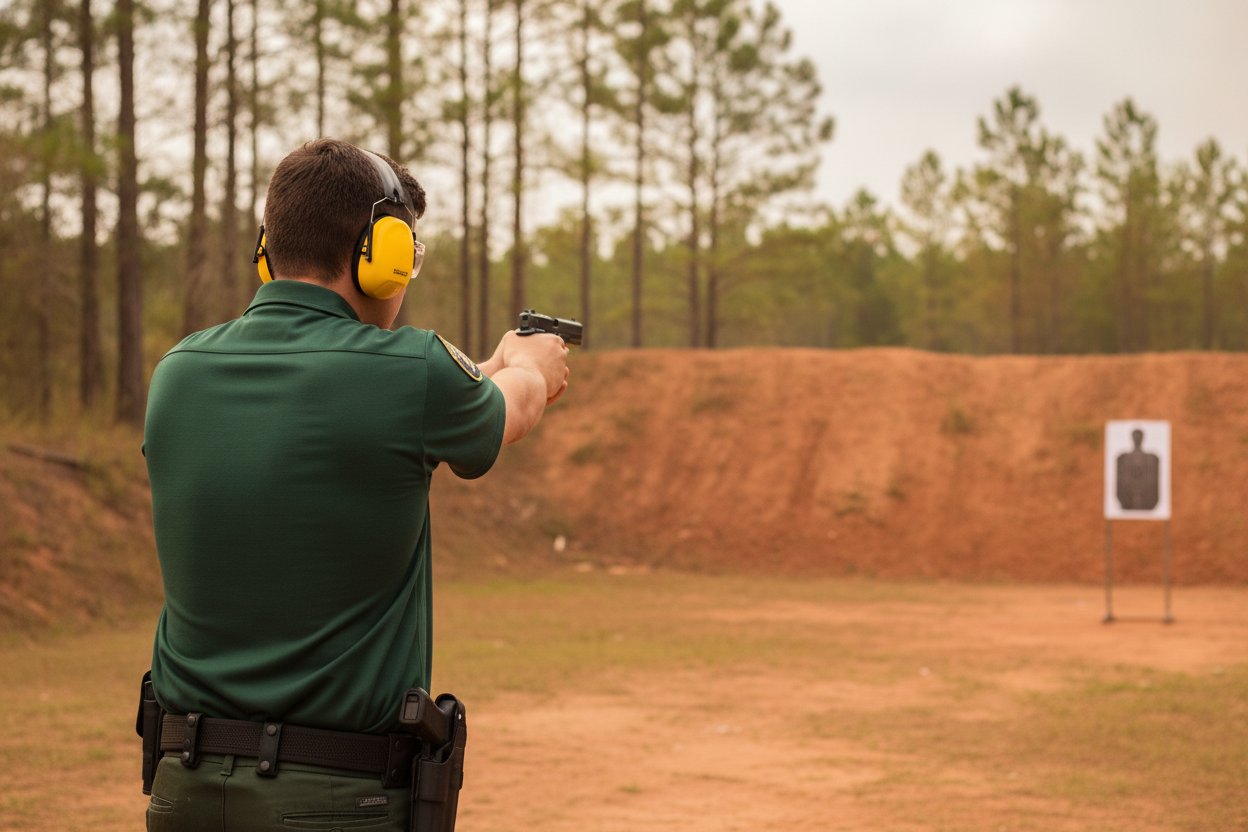
Defensive tactics, firearms handling, and the firearms proficiency exam. This is a separate booking, and we would rather you hear that from us up front than discover it later: the online course price covers the online training only, and the in-person firearms qualification is scheduled separately and is not included. Budget the time for it, and schedule it deliberately rather than assuming it will fall into place after Part 1.
If You Already Hold an LTC, Read This Part Twice
Plenty of East Texas officers come in with a License to Carry already, and the shooting half will feel familiar. The firearms proficiency exam is close to identical in format to the LTC proficiency exam, and under §35.145 the qualification may use the DPS Primary Issued Handgun Qualification Course or the DPS Approved LTC Course. §35.146 also sets out a shotgun course of fire for commissioned security officers, so you have the option to qualify with a shotgun in addition to a handgun.
The written side is where the comparison breaks down. Under §35.144(c), the minimum passing grade on Level 3 and Level 4 school examinations is 75%: a higher bar than the License to Carry written threshold. An LTC gets you comfortable on a range; it does not prepare you for the statutory material. Treat the reading seriously. If you want to see the rules in full, they live at 37 TAC Chapter 35.
This One Can’t Be Done In-House
If your Level 2 was handled internally by the company you work for, you may be expecting the same here. It does not work that way. Level 3 course material is prepared by and obtained from DPS, and the course may only be taught by a DPS-approved school using a DPS-approved instructor. A licensed company cannot put its own designee in front of a Level 3 class. The commission side of your file is administered by the Texas DPS Private Security Bureau.
A Word on Level 4
People occasionally ask whether they should just skip ahead. There is nothing to skip ahead to. Level 4 is the personal protection officer course, close protection, a different job, with a minimum of fifteen classroom hours under §35.141(a)(3). It is not a senior grade of commissioned security officer. For an armed security post in Tyler, Level 3 is the course.
Your Certificate, and What Follows
- The certificate of completion is referred to as the PSP 30.
- Under §35.147, an approved school issues the original certificate to a qualifying student within seven days of qualifying.
- The same rule requires the school to retain training records for 24 months.
- File it with your Level 2 certificate. §35.81(a) wants both when you apply.
After that, keeping the commission current is its own cycle, handled through the armed security renewal course rather than by retaking Level 3. If you are weighing which class you actually need, particularly if you have been out of the industry a while, the FAQ page is a good first stop, and the full class list shows everything we run. Ask before you buy the wrong one; we would rather answer a question than process a refund.
Leave a Reply