
You sit down for an interview at a Pasadena contract security firm, mention that you have carried for a decade and hold a current LTC, and the hiring manager asks a question that stops you cold: “Are you commissioned?” This post is about the gap between those two things.
A Personal License Cannot Do an Occupational Job
The License to Carry exists to answer a question about you as a private individual. It says nothing about you as a security officer, because it was never asked to. The security officer commission is the credential that speaks to armed work. Carrying a firearm in the course of security duties, under a licensed company, on a client’s property, in a role the public reads as authority. Texas treats those as different animals and licenses them separately.
The requirement sits in 37 TAC Chapter 35: under §35.141(a)(2), the Level 3 training course is required of anyone seeking a security officer commission, and of personal protection officers. Not “unless you already carry.” Not “or equivalent experience.” The rule does not contemplate a substitute, and a hiring manager at a Ship Channel facility has no discretion to accept one.
Nor does the course replace the step before it. Under §35.81(a), the commission application asks for copies of both the Level 2 and the Level 3 certificates of completion, alongside the other items DPS lists. So if you are coming into the industry fresh with an LTC in your wallet, your path still begins with the unarmed Level 2 Security Officer class, and you hold onto that certificate, because you will be attaching it to the application later.
Now the Good News: You Have Already Shot This Test
Everything above is the correction. Here is the part where your LTC genuinely counts for something. The firearms proficiency exam you will shoot for a commission is close to identical in format to the Texas LTC proficiency exam. That is by design rather than accident: §35.145 provides that the qualification may be conducted using either the DPS Primary Issued Handgun Qualification Course or the DPS Approved LTC Course. If you have already stood on a line and shot the LTC course clean, the range day is familiar ground.
There is more on offer, too. §35.146 sets out a shotgun course of fire for commissioned security officers, which means qualifying with a shotgun as well as a handgun is available to you if the posts you are chasing want it.
Where the Two Really Diverge: the Written Exam
The classroom half is where Level 3 does work an LTC class never attempted. It covers the law governing armed security work, use of force, and the specific duties that attach to a commission. The responsibilities you take on the moment you are the armed person on someone else’s site. And the bar is set higher than most people expect: under §35.144(c), the minimum passing grade on Level 3 and Level 4 school examinations is 75%. That is above the LTC written threshold. Experienced shooters are the students most likely to be caught out by it, precisely because they assume the range is the hard part.
And no, Level 4 is not “the next one up”
While we are dismantling assumptions: Level 4 is a different credential, not a higher one. Level 3 is the commissioned security officer. Level 4 is the personal protection officer, close protection work, and it is its own course with a minimum of fifteen classroom hours under §35.141(a)(3). If you want an armed post at a plant, a hospital or a bank, Level 3 is the class you want.
Pasadena Is a Commissioned-Officer Market
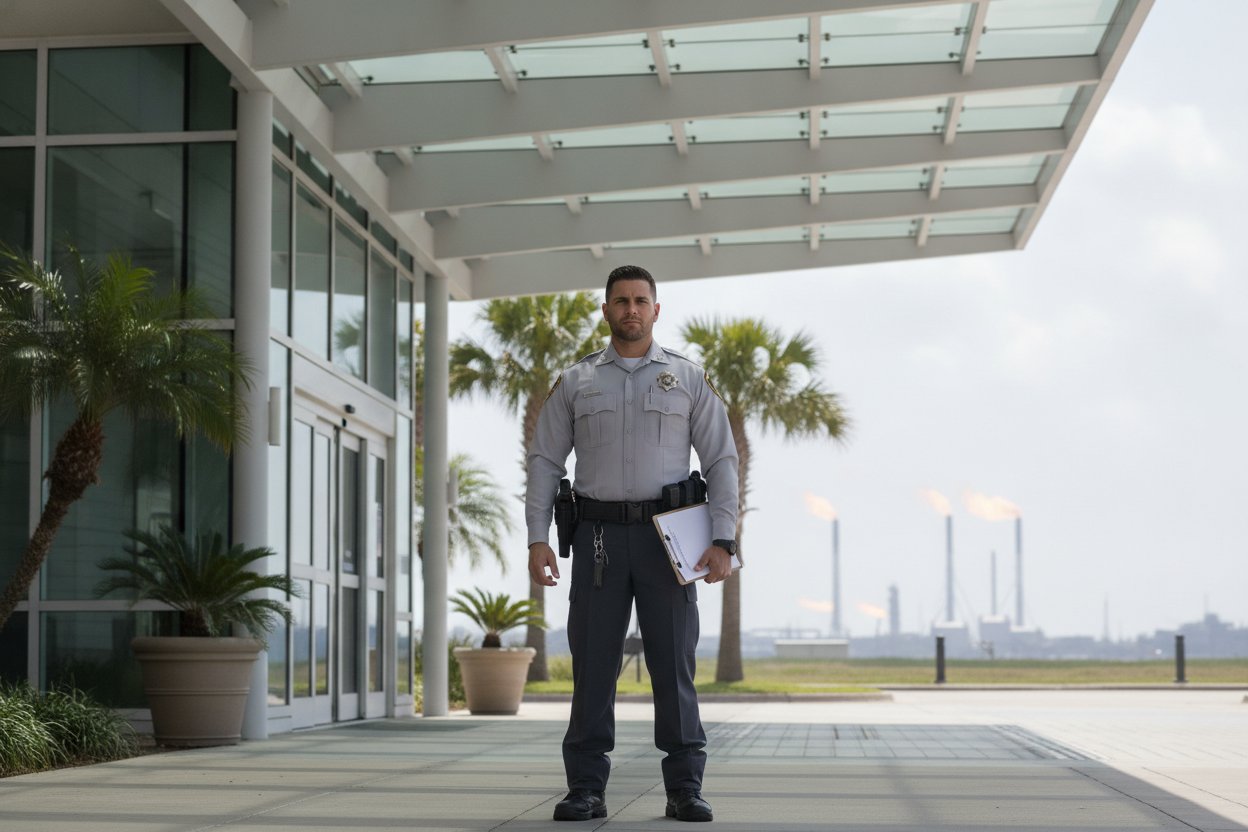
Few places in Texas have as concentrated a demand for armed security as the petrochemical corridor along the Houston Ship Channel. Industrial plant gates, tank farms, terminal access points and contractor checkpoints are exactly the kind of controlled-access posts that get staffed with commissioned officers rather than unarmed ones. Add the medical facilities, the banking branches, the distribution and logistics sites feeding the port, and the gated corporate campuses inland, and Pasadena supports a steady base of armed contracts. All of which screen on the commission, not on a personal carry license.
How the Course Is Delivered
- Part 1 is online: the classroom material and the written exam. ETXSTA delivers this portion 100% online.
- Part 2 is in person: defensive tactics, firearms handling, and the firearms proficiency exam.
- The online course price covers the online training only. The in-person firearms qualification is scheduled separately and is not included.
- The material is prepared by and obtained from DPS, and Level 3 may only be taught by a DPS-approved school with a DPS-approved instructor: a licensed company cannot run it in-house through its own designee the way it can with Level 2.
- Under §35.147, the school issues your original certificate of completion (PSP 30) within seven days of qualifying and keeps training records for 24 months.
One last thing to keep on your radar: the commission is issued by DPS on application, and once you hold it, keeping it current is a separate obligation handled through the armed security renewal course. The licensing side belongs to the Texas DPS Private Security Bureau, and the full class list shows how the courses stack up.
Leave a Reply