
The first question almost every Round Rock caller asks is some version of “how fast can I actually start working?” It is a fair question, and the honest answer has two halves: one you control, and one you don’t.
The Sequence, in Order
There are four stages between deciding to do this and being eligible to work an unarmed post in Williamson County. Knowing which one you are standing in saves a lot of guessing.
- The Level 2 course. Our version runs 100% online, so this stage moves at whatever pace you set.
- The certificate of completion. Referred to on our site as PSP 36, it is the document that proves the training happened.
- The license application. The certificate has to be submitted with your application for a non-commissioned security officer license.
- The wait. This one belongs to the state, not to you and not to us.
Stage One: The Course Itself
Level 2 is the entry-level, unarmed course. Under 37 TAC §35.141(a)(1) it has to be completed by anyone applying for a non-commissioned security officer license, and it is also the required first step for anyone who later wants a security officer commission. The material is prepared or approved by the Texas Department of Public Safety and covers Texas security law, the professional responsibilities of a security officer, emergency procedures, and ethics.
Be clear on what this stage is not. There is no firearms training and no firearms qualification anywhere in Level 2. Nobody goes to a range, nobody handles a weapon, and finishing it does not by itself let you carry anything on duty. That is a separate credential on a separate timeline, and we will come back to it.
One wrinkle worth knowing before you enrol: Level 2 may be delivered either by the licensee’s own designated person or by a DPS-approved school with a DPS-approved instructor (§35.141(a)(1), §35.142, §35.143). If a Round Rock company has already hired you and runs its own designated training in-house, you may not need to buy the class. If you are training ahead of a job offer, which is most people, then the approved-school route through our online Level 2 class is the one that applies.
Stages Two and Three: Paper Moves Faster Than People Expect
Once the coursework is finished, the certificate is issued and it goes in with your application. That hand-off is usually the quickest part of the whole process, which is exactly why it is worth getting the course done before you start chasing interviews rather than after.
Stage Four: The Part Nobody Can Promise You
Here is where we stop giving you a number. Application processing belongs entirely to the Texas DPS Private Security Bureau. Volume, background checks and the completeness of your own paperwork all move that clock, and no training school, ours included, has any influence over it. Any school that quotes you a guaranteed turnaround is telling you something it cannot know. Treat the training as the part you can finish this week and the state’s review as the part you plan around.
What the License Opens Up Around Round Rock
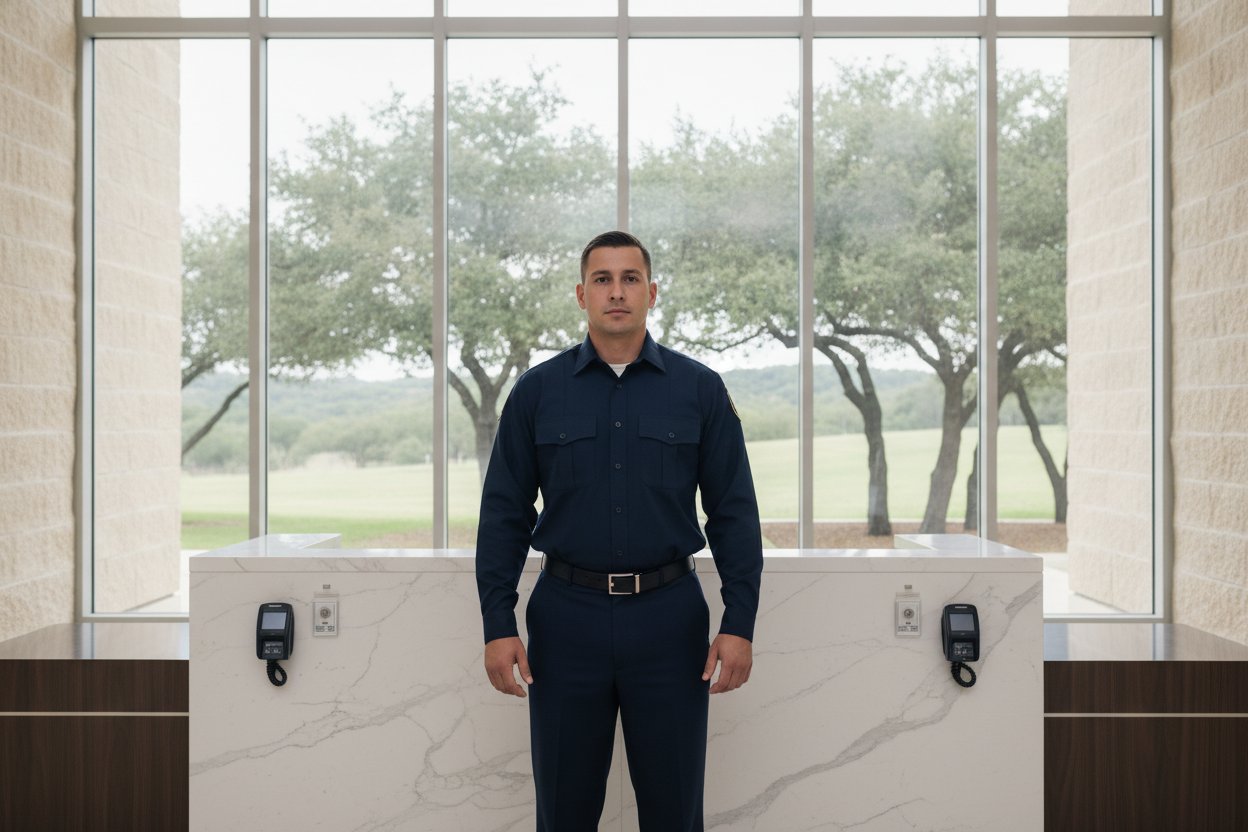
Round Rock sits in the corridor where Austin’s growth has spilled north along I‑35, and the resulting mix, corporate campuses and office parks, a large retail and outlet trade, hospitals and outpatient clinics, distribution space, and a steady stream of new residential communities, is almost entirely unarmed-officer territory. Lobby and badge desks, warehouse gates, apartment communities, construction-site access and event staffing are the posts that hire here, and none of them require a commission. A Level 2 license is the credential those jobs are actually asking for.
A Timeline Detail in Your Favor
Noncommissioned security officers are specifically exempt from continuing education requirements under §35.161(b). That is unusual enough that people assume we have misread it, so read it yourself in 37 TAC Chapter 35. It means the timeline above is largely a one-time sequence rather than a recurring obligation.
That changes the day you decide to carry. The commission pathway starts with the Level 3 course, and once you hold a commission the renewal course becomes part of keeping it current. Plenty of officers work unarmed posts around Williamson County for years first, which is a perfectly reasonable order of operations. If you are still weighing which class you need, our FAQ page works through the usual crossroads.
Leave a Reply